EXHIBITION DESIGN
The yearly ritual of taking Christmas ornaments out of their boxes to arrange them on a tree is perhaps the closest a household comes to preparing an exhibition: both a family collection and a museum display involve a sense of wonder in a transitional moment, when an archive becomes a presentation. For the display of more than 700 historical Christmas ornaments from the Gablonz region (today Jablonec nad Nisou, Czech Republic) at Museum of Applied Arts Vienna, designer Johanna Pichlbauer developed a scenography based on this moment of wonder:
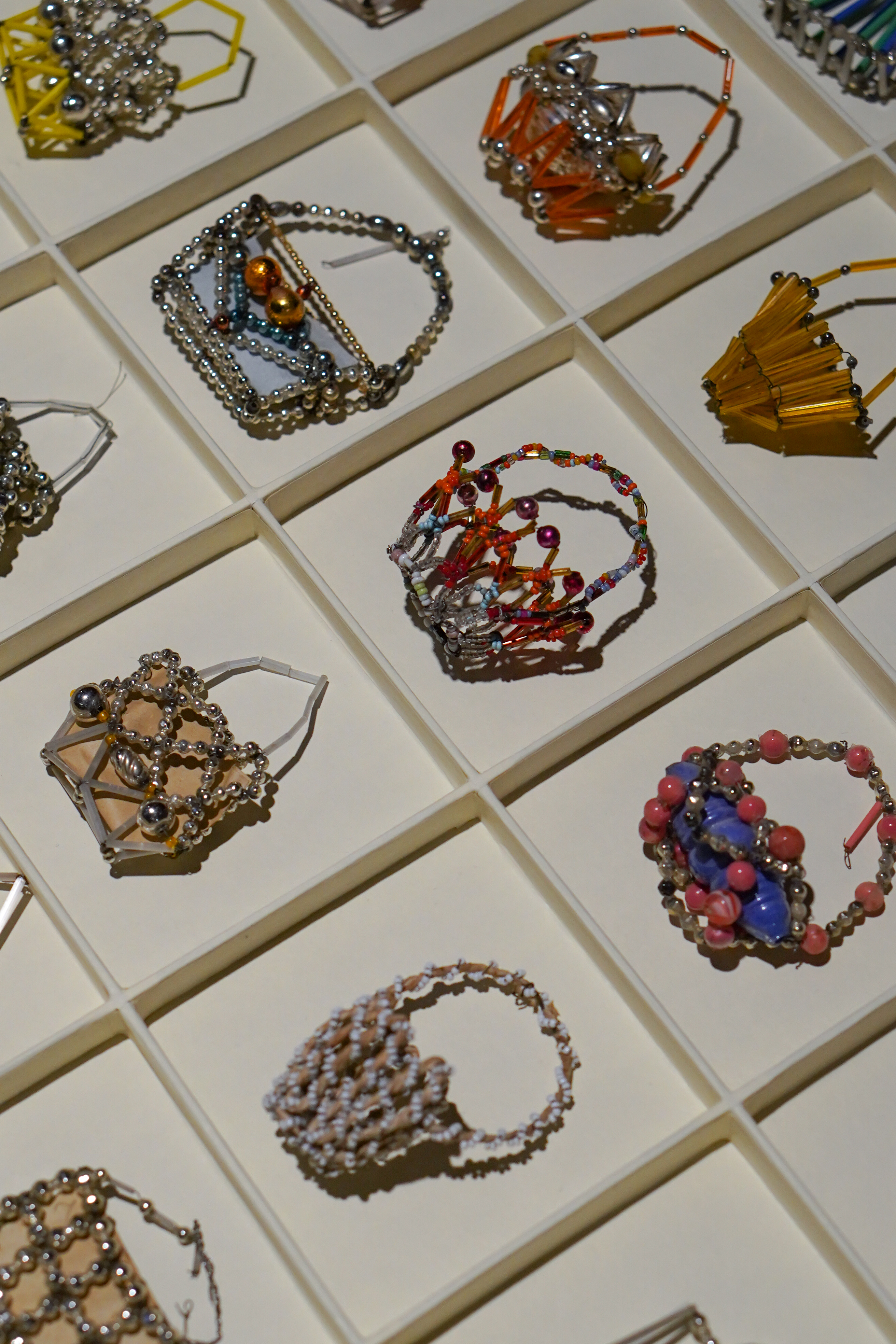
Cardboard boxes — the containers in which the ornaments are typically bought but also hidden in for most of the year — are reinterpreted as modular display elements. Labeled and titled, each box forms a narrative unit to pay tribute to the whimsical nature of Gablonz Christmas ornaments, which popularly and surprisingly include not only angels and stars but also miniatures of everyday objects — from airplanes, slide rules, and handbags to spiders and frogs.
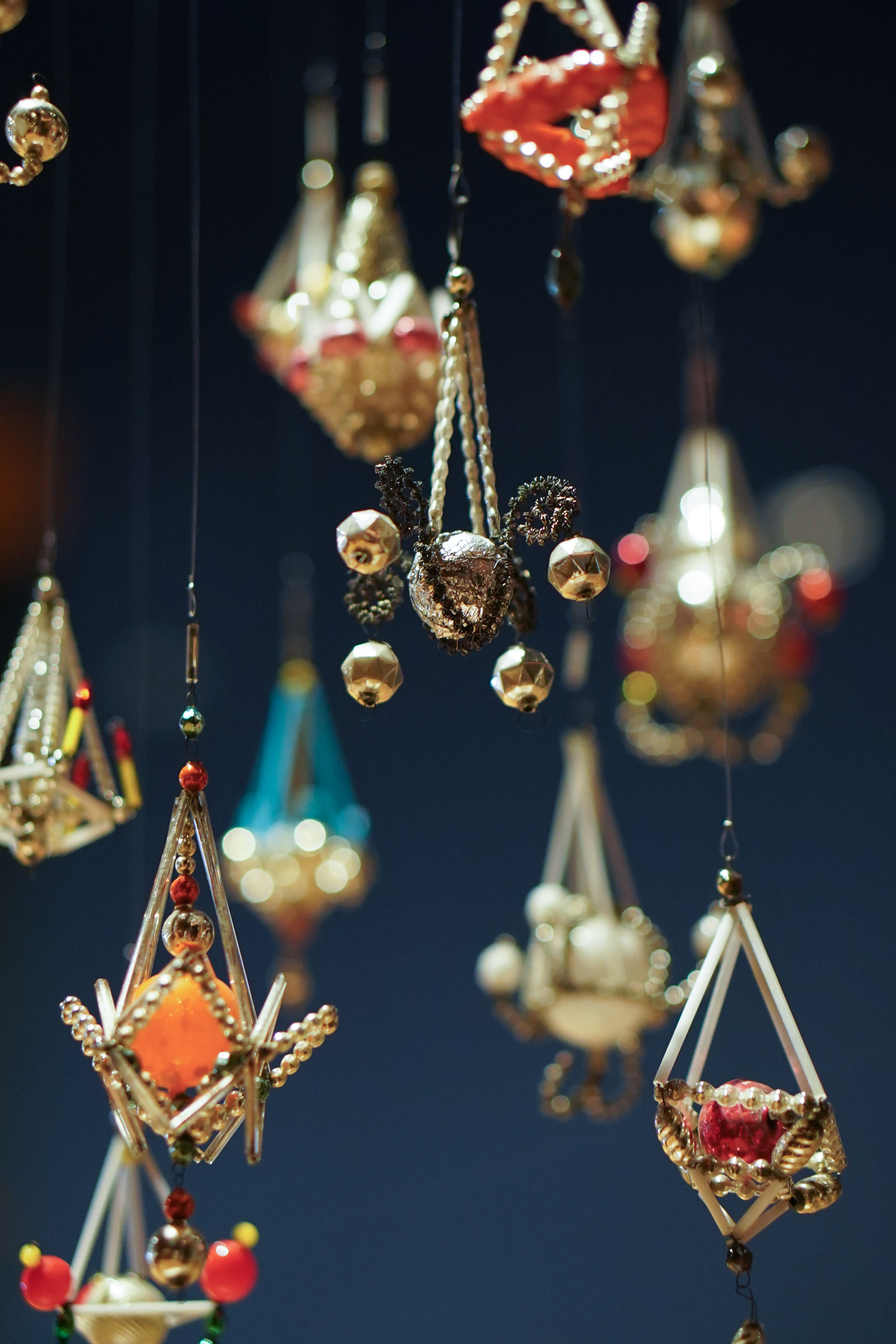
Additional ornaments are suspended from simple, graphical lustres, whose subtle decoration mirrors the ornaments’ smallest component—the bead. Hanging freely, they surround visitors, immersing them in a glittering cosmos.
The exhibition was curated by Kathrin Pokorny-Nagel to mark the gifting of the collection to the Museum by Waltraud Neuwirth. It was shown in the Works on Paper Room of the Museum of Applied Arts Vienna between September 2025 and February 2026.
︎ MAK Wien
︎ 24.9.2025—1.2.2026
Fotos: Esel.at (unten), Pichlbauer (links)
Fahrrad und Hummer
The yearly ritual of taking Christmas ornaments out of their boxes to arrange them on a tree is perhaps the closest a household comes to preparing an exhibition: both a family collection and a museum display involve a sense of wonder in a transitional moment, when an archive becomes a presentation. For the display of more than 700 historical Christmas ornaments from the Gablonz region (today Jablonec nad Nisou, Czech Republic) at Museum of Applied Arts Vienna, designer Johanna Pichlbauer developed a scenography based on this moment of wonder:
Cardboard boxes — the containers in which the ornaments are typically bought but also hidden in for most of the year — are reinterpreted as modular display elements. Labeled and titled, each box forms a narrative unit to pay tribute to the whimsical nature of Gablonz Christmas ornaments, which popularly and surprisingly include not only angels and stars but also miniatures of everyday objects — from airplanes, slide rules, and handbags to spiders and frogs.
Additional ornaments are suspended from simple, graphical lustres, whose subtle decoration mirrors the ornaments’ smallest component—the bead. Hanging freely, they surround visitors, immersing them in a glittering cosmos.
The exhibition was curated by Kathrin Pokorny-Nagel to mark the gifting of the collection to the Museum by Waltraud Neuwirth. It was shown in the Works on Paper Room of the Museum of Applied Arts Vienna between September 2025 and February 2026.
︎ MAK Wien
︎ 24.9.2025—1.2.2026
Fotos: Esel.at (unten), Pichlbauer (links)


The dark blue velvet star curtain freatures the "Winter Hexagon" — a prominent configuration of bright first-magnitude stars in the southern winter sky. It consists of the following fixed stars (clockwise): Capella in Auriga, Aldebaran in Taurus Rigel in Orion, Sirius in Canis Major Procyon in Canis Minor, and Pollux in Gemini.